
Guides
The term report is too late to be useful
A term report tells a parent in December what the school knew in September. Weekly grades are the other rhythm, a mark per subject per week, published a week at a time.
A parent asks how their child is doing. For most of the term, the school's honest answer is that they will find out in December.
That is not a school being evasive. It is the shape of the term report. Marks are collected across three months and published once, at the end, when the term is over and nothing about it can be changed. By the time a parent reads that their son stopped keeping up in Maths, the weeks in which somebody could have sat down with him have already gone.
Schools know this, which is why so many run something alongside it: a book that goes home on Fridays, a WhatsApp group, a "continuous assessment" sheet that never quite becomes anything. Weekly grades are that habit, built properly.
What it is
A mark per pupil, per subject, per academic week. Recorded as the week goes, published to families a week at a time, and optionally carried onto the term report card so the weekly record is not a parallel system that ends in a drawer.
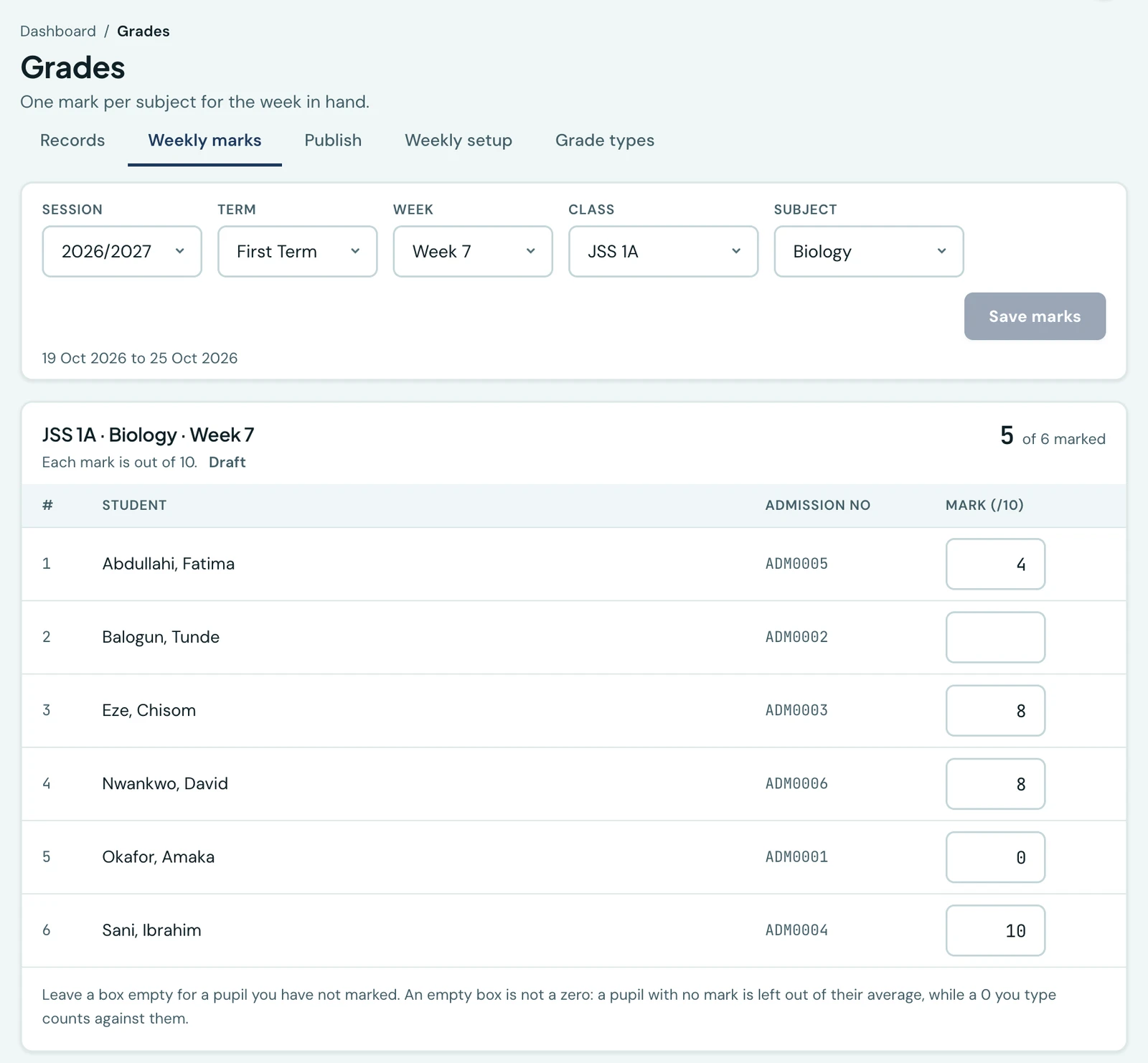
A teacher opens the week, sees their class down the page and the subjects across it, and fills in what they have. A head teacher publishes the week when it is done. Families see the week, and the term so far as a mark book, subjects down and weeks across.
The four decisions that took longer than the code
A missing mark is not a zero
This is the one that matters most and is easiest to get wrong.
No mark means no row. It sits outside every average, and the average is over the marks that exist. A
recorded 0 is a different thing entirely, and it counts. Clearing a box deletes the row rather than
storing a nothing that later reads as a nought.
A child who was absent on Thursday has not scored nothing. A subject that was not taught this week has not scored nothing either. Any system that quietly turns "no mark" into a zero will show a diligent child's average falling through a term in which nothing at all went wrong.
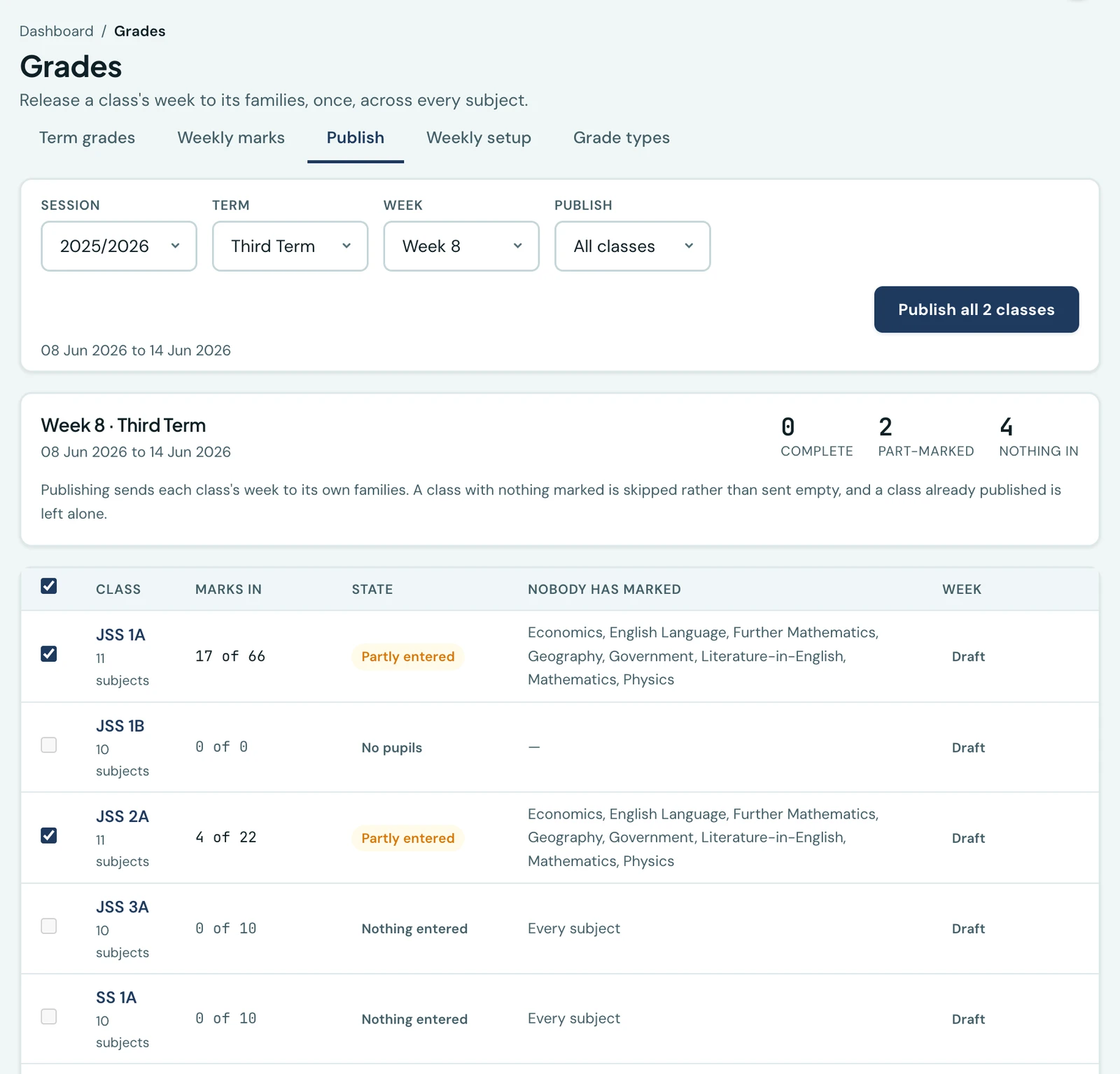
The week is the unit of publication
Not the mark, and not the subject.
A teacher can mark all week without a family seeing anything, and nothing becomes visible until the school publishes that week. There is no half-published week, no subject that leaks ahead of the others, and no mark that a parent sees before the school meant them to.
This also means a family-facing screen never has to ask whether a particular mark is ready. It asks which weeks were published and reads those.
A week that has not begun cannot be marked
The academic calendar already knows which weeks a term has, because it derives them from the term dates and the school's own week. Weekly grades ask it, rather than introducing a second idea of what week 4 is.
So a week that has not started refuses marks, and says which situation it is in. A week that has not begun resolves itself on Monday. A locked week needs an administrator. Those are different problems and they get different sentences.
Subjects are graded weekly until you say otherwise
Rather than the other way round.
A school that has to opt each subject in ends up with three of them marked, because opting in is a job somebody has to remember to finish. A school that wants to exclude a subject knows which one it is and can say so in a moment.
Why we do not send these on WhatsApp
We are asked this, and the answer is a real constraint rather than a preference.
The platform sends WhatsApp through one business phone number, which is capped at 250 business-initiated conversations a day across every school on 1410SMS. One school publishing one week to its families exceeds that on its own, and the schools that would lose their fee reminders and absence alerts that day would be the other ones.
So weekly grades go out by email, in the app, and as a push notification, and we say why rather than offering a WhatsApp toggle that silently drops most of what it is given.
Who can do what
Recording is a teacher's job and follows the same rule the rest of grading does: a teacher may mark a class that is one of their homerooms, or a subject they teach. Publishing and locking are separate permissions, because collecting marks and telling four hundred families are different acts.
On the phone, locking asks for confirmation and unlocking does not. That asymmetry is deliberate: a lock stops the teacher who has just spotted a wrong mark, and the person doing it should know that before they tap. Unlocking only hands that back. On the web the one act that confirms is publishing, which is the one that leaves the building.
Starting
Turn it on for the subjects you actually want it for, tell your teachers which day the week closes, and publish the first week yourself before delegating it. The habit is the hard part. The software is now the easy part.
Keep reading
Operations
Your school knows who was in class. Does it know who was teaching?
The pupils' register is taken every morning. Staff attendance is a signing book on the front desk. Here is how we built the second one, and the four things we deliberately refused to do.
Read article
Operations
Nobody should draw an exam timetable in pencil
One person draws the exam grid, one paper moves, and the whole thing needs checking again by eye. Usually it is not. Here is the workspace that replaced the pencil.
Read article
Ready to try it with your school?
Three-month Basic trial. No card required to register.